Replacement Engines is Committed to Offer Customers a Cost Effective Solution to their Engine Problems
Land Rover Defender Engine Replacement: The Complete UK Buyer’s Guide — Used, Reconditioned, or New?

Website: Replacement Engines | Author: Christopher Bailey | Date: 21 July 2026
Your Land Rover Defender’s Engine Has Failed — Here Is Exactly How to Find, Verify, and Buy the Right Replacement in the UK
A Land Rover Defender replacement engine in the UK costs between £1,800 and £7,000+ depending on your chosen route: (1) a tested used 300Tdi costs £800-£1,400 for the engine plus £700-£1,000 fitting, (2) a reconditioned Td5 ranges from £2,000-£3,500 supply-and-fit, (3) a brand-new Puma TD4 from Land Rover costs £4,500-£6,500, and (4) a specialist engine conversion (e.g., Cummins 2.8, BMW M57) ranges from £5,000-£12,000. To compare engine prices UK buyers trust for the Defender, your first decision is which engine route you want — and that depends on your budget, usage, and how long you plan to keep the vehicle.
The Land Rover Defender isn’t a vehicle you scrap when the engine fails. It’s an appreciating asset that deserves a properly sourced replacement — but the Defender engine market is complicated. Depending on your model year, you could be dealing with a 200Tdi, 300Tdi, Td5, TD4 Puma, or a conversion to a non-standard engine. Each path has different sourcing channels, price brackets, and pitfalls. This guide maps them all.
Which Land Rover Defender Engine Does Your Vehicle Actually Have?
Before sourcing a replacement, confirm exactly which engine you have: 200Tdi (1990-1994 — mechanical injection, no ECU, simple to swap), 300Tdi (1994-1998 — improved version, still mechanical, widely available used), Td5 (1998-2006 — electronic unit injectors, ECU-controlled, more complex installation), TD4 Puma (2007-2016 — Ford Transit-derived 2.4 or 2.2 diesel, common-rail, requires ECU marriage), or a previous owner’s conversion (check the V5C — a conversion may not be registered). Buying the wrong engine type for your vehicle is a £1,500-£3,000 mistake that can’t be returned.
A detail most workshops hope you never ask about is that many used Defender engines sold as ‘tested’ have never been compression-tested or run since being removed from the donor vehicle. The engine was ‘running when removed,’ but the seller doesn’t know — and can’t verify — whether it was running well. It’s a bodge situation, really. Demand a cold compression test video (showing the gauge on each cylinder) and a written guarantee that the engine has been bench-tested before purchase. Without these, you are buying a lottery ticket, not an engine.
The Four Replacement Routes: Costs, Pros, and Cons for Your Land Rover Defender
| Route | Engine Cost | Fitting | Total | Pros | Cons |
| Used 300Tdi | £800–£1,400 | £700–£1,000 | £1,500–£2,400 | Cheapest, simplest, no ECU | Ageing engines, limited warranty |
| Reconditioned Td5 | £1,500–£2,200 | £1,000–£1,300 | £2,500–£3,500 | Near-new reliability, ECU included | Expensive, complex electronics |
| New Puma TD4 (LR) | £3,500–£5,000 | £1,000–£1,500 | £4,500–£6,500 | Factory warranty, latest spec | Very expensive, ECU marriage needed |
| Engine Conversion | £3,000–£8,000 | £2,000–£4,000 | £5,000–£12,000 | Better power/reliability | Resale uncertainty, DVLA declaration |
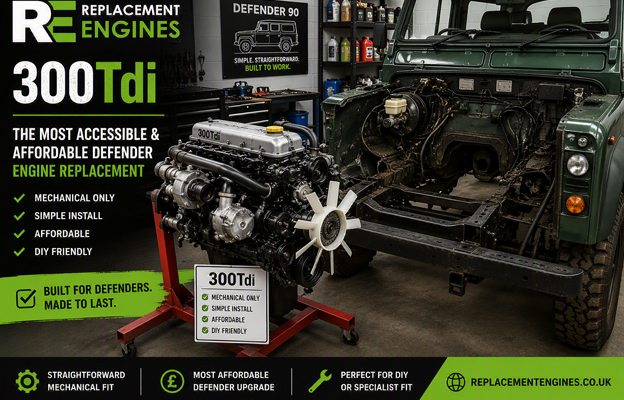
The workshop-floor truth rarely shared with customers is that the 300Tdi is — pound for pound — the best-value Defender engine on the UK market. It’s mechanically injected (no ECU, no immobiliser, no coding), has been in production for 30+ years (parts are everywhere), and any competent independent mechanic can fit one in a day. The Td5 offers more refinement and power but introduces electronic complexity that adds £500-£1,000 to any diagnosis or repair. If reliability and repairability are your priorities — not refinement — the 300Tdi is the answer.
How Do You Verify a Used Land Rover Defender Engine Before Buying?
The five-point verification for a used Defender engine: (1) Cold compression test — demand video showing gauge readings on each cylinder. For a 300Tdi, 24-28 bar per cylinder is healthy; below 20 bar indicates significant wear. (2) Engine number verification — check against the DVLA database and ensure it’sn’t recorded as stolen. (3) Mileage verification — demand a photograph of the donor vehicle’s odometer and a written statement of mileage. (4) Run test — insist on seeing the engine running before removal or, if already removed, a bench-start video. (5) Warranty — minimum 3 months in writing, covering full refund if the engine fails compression test after installation.
Real Case Study: A 1995 Land Rover Defender 110 300Tdi Reborn
One of our customers, Thomas, owns a 1995 Defender 110 County Station Wagon — a family heirloom with 187,000 miles on the original engine. The 300Tdi developed a severe knock diagnosed as a big-end bearing failure. A Land Rover specialist quoted £2,100 for a bottom-end rebuild. A used engine supplier offered a ‘tested’ 300Tdi for £950.
Right, so thomas chose the used engine route but demanded the five-point verification. The first three engines he inspected failed verification — one had compression readings of 16-19 bar, one had no mileage verification beyond ‘trust us,’ and one couldn’t be seen running. The fourth engine — removed from a written-off Discovery with 94,000 verified miles — passed all checks with compression between 26-28 bar on all cylinders. Engine cost: £1,100. Fitting by an independent specialist: £800 including new timing belt and water pump. Total: £1,900. The Defender is back in daily use and has covered 24,000 trouble-free miles since the replacement.
The Defender engine market is split into four clear paths — each with different costs, reliability implications, and resale effects. This article provides a decision tree: standard replacement (same engine type), upgrade replacement (newer Land Rover engine), specialist conversion (non-Land Rover engine), or full rebuild. For each path, you’ll find real UK pricing, verified supplier recommendations, and the documentation you must demand before paying.
Bottom Line for Owners
Explore More about Land Rover Engines
- Second Life for Your Land Rover Range Rover: Used and Reconditioned Land Rover Range Rover Engine
- Why Is Your Defender 2.4 Losing Power? EGR & Turbo Faults Explained & Fixed
- Before You Search Another Listing, Read This: Reconditioned Land Rover Discovery II Engine—What Terms Are They Hiding Behind?
- Cost of a Used Land Rover Defender Engine in the UK: What Owners Actually Pay in 2025
Frequently Asked Questions
1. How much does a Land Rover Defender engine replacement cost in the UK?
Costs range from £1,500 for a used 300Tdi fitted to £12,000 for a specialist engine conversion. A reconditioned Td5 supply-and-fit falls in the £2,500-£3,500 range. To compare engine prices UK buyers trust for the Defender, decide your engine route first, then source quotes from at least three verified suppliers for that specific route.
2. Which Land Rover Defender engine is the most reliable?
The 300Tdi is widely considered the most robust Defender engine. Its mechanical simplicity — no ECU, no complex electronics, gear-driven camshaft — means fewer failure points. The Td5 is more refined but has known issues with oil in the ECU loom and injector harness failure.
3. Is a Defender engine conversion legal in the UK?
Yes, but the DVLA must be notified of the engine number, capacity, and fuel type change. If the conversion significantly alters the vehicle’s power output (more than 15% increase), you must also notify your insurer. Failure to declare a conversion can invalidate your insurance and result in prosecution.
4. Can I fit a Discovery engine into my Defender?
Yes — the 300Tdi and Td5 engines are shared across the Defender and Discovery ranges. However, the ancillaries (turbo, manifolds, engine mounts) differ between models and must be retained from your existing engine or sourced separately.
5. How long does a Defender engine replacement take?
A 300Tdi replacement by an experienced independent Land Rover specialist takes 1-2 working days. A Td5 takes 2-3 working days due to the additional electronic integration and ECU coding required. An engine conversion can take 2-4 weeks depending on the complexity of the installation.
6. Does a replacement engine affect my Defender’s value?
A documented original-spec replacement (same engine type) preserves or enhances value. A non-standard conversion can either increase value (if it’s a desirable upgrade like a Cummins or BMW M57) or decrease it (if it’s a poorly documented unknown swap). The paperwork is critical — a full service history with the new engine is worth {G}1,000-{G}2,000 at resale.
7. How do I find a trustworthy Land Rover engine supplier in the UK?
Use an engine price comparison tool UK service to view verified quotes from Land Rover engine specialists. Look for suppliers who are members of the Federation of British Historic Vehicle Clubs or have Land Rover specialist accreditation, and who are willing to provide the five-point verification documentation before you pay.
A Defender without an engine isn’t a write-off — it’s a project waiting for the right replacement. Whether you choose a used 300Tdi, a reconditioned Td5, or a specialist conversion, the key is verifying what you are buying before the money leaves your account.
Find Your Replacement Engine — Enter Your Registration