Replacement Engines is Committed to Offer Customers a Cost Effective Solution to their Engine Problems
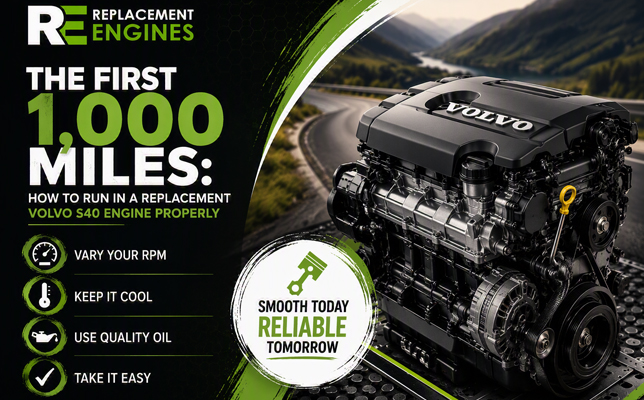
The First 1,000 Miles: How to Run in a Replacement Volvo S40 Engine Properly
Website: Replacement Engines | Author: Christopher Bailey | Date: 24 July 2026
A newly fitted Volvo S40 engine starting cleanly doesn’t mean it’s ready for normal driving. The rings, bearings, turbo seals and oilways still need controlled load cycles to bed in properly. This guide covers how to run in a replacement engine correctly over the first 500–1,000 miles, why the specific engine code changes the advice, and — just as importantly — how to confirm the original failure cause was actually fixed before you even start driving.
A Fresh Engine Still Needs to Learn to Breathe
A newly fitted engine starting cleanly doesn’t mean it’s ready for normal driving. The rings, bearings, turbo seals and oilways still need controlled load cycles to bed in properly. Treat the car for its first few hundred miles as if it’s relearning how to breathe, not as a finished repair you can immediately forget about.
One risk owners don’t expect: early glazing of the cylinder bores can happen if the car sits at one steady motorway speed for too long during this period. Varied speed and load — not a gentle, constant cruise — is what actually helps the rings seat correctly.
It’s a counterintuitive point worth repeating: many owners assume the safest thing to do with a freshly repaired engine is drive it as gently and steadily as possible. In practice, that steady, low-variation driving is one of the more common ways owners inadvertently undermine a rebuild in its most vulnerable early period.
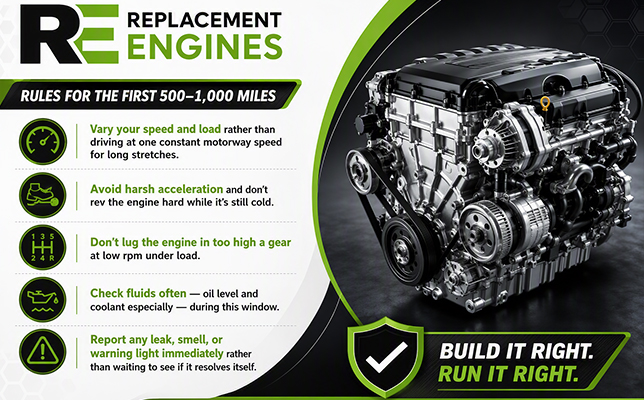
Rules for the First 500–1,000 Miles
- Vary your speed and load rather than driving at one constant motorway speed for long stretches.
- Avoid harsh acceleration and don’t rev the engine hard while it’s still cold.
- Don’t lug the engine in too high a gear at low rpm under load.
- Check fluids often — oil level and coolant especially — during this window.
- Report any leak, smell, or warning light immediately rather than waiting to see if it resolves itself.
None of this means driving nervously or under-using the car. A mix of urban stop-start, some A-road overtaking, and a reasonable amount of motorway running — without holding one fixed speed for an hour — gives the rings and bearings exactly the variety of load they need.
Why the Engine Code Actually Changes the Advice
The S40 range used a wide spread of petrol and diesel units — including B4164S3, B4184S8, B4204S3, D4164T, D4204T and D5244T variants — and a blanket run-in instruction genuinely isn’t good enough across all of them. A 1.6 diesel and a 2.4 five-cylinder petrol don’t build heat or turbo load in the same way, so the pacing of the first few hundred miles should reflect your specific engine, not a generic rule of thumb.
A run-in plan worth following matches the engine code, fuel type, ECU adaptation behaviour and cooling system layout — ask your fitting specialist for guidance specific to your variant rather than relying on general advice alone.
Turbocharged variants in particular need a specific consideration the naturally aspirated engines don’t: avoid switching the engine off immediately after a hard, sustained motorway run during the run-in period, to give the turbo bearing a moment to cool rather than being starved of oil circulation the instant it’s needed most.
Rule Out the Original Cause Before You Even Start the Run-In
Fitting a new engine without addressing why the old one failed is the single most common way to kill a replacement just as quickly. Before starting the run-in period, confirm the root cause was actually fixed — not just the symptom.
- Cold-start rattle near 1,500 rpm that fades as oil pressure rises — was this fully investigated, or just noted?
- Blue smoke after overrun — usually valve stem seals or turbo wear, and worth confirming was addressed on the old unit’s failure report.
- Milky oil, pressurised coolant, or repeated overheating — a cooling system fault that, if unresolved, will damage the replacement exactly as it did the original.
- P0190 or P0171-style fuelling faults causing lean running — confirm these were traced to a specific component, not just cleared from the code reader.
- Oil leaks around the turbo return pipe, sump joints or cooler seals — starve the new engine of oil pressure the same way the old one may have been starved.
If the cooling fan, a blocked DPF, an injector leak-off fault, or a failed thermostat wasn’t sorted before the swap, the replacement engine is walking into the same trap that killed the last one.
The First Service After a Replacement
Treat the first service interval after a replacement as genuinely different from a routine one. Many specialists recommend bringing this forward — often to around the 1,000-mile mark rather than the standard interval — specifically to catch any fine metal particles generated during initial bedding-in before they can circulate and cause secondary wear.
This is also the point to have the specialist re-check for any leaks, re-torque anything that settles after initial heat cycling, and confirm the fault that killed the original engine hasn’t shown any early sign of returning.
Frequently Asked Questions
How long should I avoid motorway driving after a replacement engine?
You don’t need to avoid it — varied speed is actually better than avoiding motorways entirely. The key is not holding one constant speed for extended periods; mixing in some urban and A-road driving alongside motorway miles is ideal during the first 500–1,000 miles.
Is synthetic oil safe to use during the run-in period?
Ask your fitting specialist — some rebuilders recommend a conventional or semi-synthetic oil for the very first service interval specifically to aid ring seating, before switching to full synthetic afterward. This varies by engine code, so don’t assume the same answer applies across the S40 range.
What’s the single biggest run-in mistake owners make?
Treating the first drive as a normal drive. A gentle, cautious approach that avoids all load is almost as unhelpful as thrashing the engine — controlled, varied load is what actually helps components bed in correctly.
Should I get an oil and filter change earlier than usual after a replacement?
Yes, typically — many specialists recommend a shorter first-service interval (often around 1,000 miles) specifically to remove any fine metal particles generated during initial bedding-in, before returning to a normal service schedule.
How do I know if the original failure cause was actually fixed, not just the symptom?
Ask for it in writing — a proper diagnosis report should state what was found (e.g., “failed thermostat causing overheating”) rather than just “engine replaced.” If the paperwork doesn’t explain the root cause, ask directly before the car leaves the workshop.
Is there anything specific to do differently on a turbocharged S40 during run-in?
Yes — avoid switching the engine off immediately after a hard, sustained run during this period, giving the turbo bearing a brief moment to settle rather than being starved of oil circulation right after the heaviest load.
What should I do if I notice a leak or unusual smell during the run-in period?
Report it to your specialist immediately rather than waiting to see if it resolves on its own. Faults caught in the first few hundred miles are usually far cheaper to address than the same fault left to develop over thousands.
Bottom Line
A replacement engine’s long-term reliability is decided almost as much in the first 1,000 miles as it was in the rebuild itself. Confirm the original fault was properly diagnosed and fixed, then drive with varied load and genuine attention during the run-in period rather than treating the job as finished the moment the car leaves the workshop.
Ask your fitting specialist for a written root-cause diagnosis and an engine-code-specific run-in plan before you drive the car away.
Editorial note: guidance reflects general good practice for freshly rebuilt or replaced engines and specific detail should always be confirmed with the specialist who carried out your fitting, given the range of engine codes used across the S40 range.